
The "Beltway Sniper" Case - Page two
Analyzing Bullet and Wound Ballistic
Page Two of Six
Cartridge Case
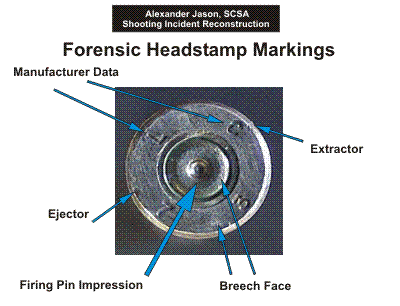
Much data can be discerned from an examination of the empty cartridge case, which can lead to the identification or "match" of the cartridge case to a particular firearm. When a cartridge is chambered, fired, and ejected, parts of the firearm come in contact with the brass cartridge case and leave impressions which can be individually identified to a particular firearm.
But this data cannot currently be used to locate or identify the shooter. There are several states that require "ballistic fingerprinting" of firearms sold, but they presently only include handguns, not rifles.
Bullet Evidence

We apparently don't yet know the type of weapon used. The report about the "AK-74" turned out to be phony. There are many weapons which will fire the .223 cartridge and within those weapons, there are many variants which may use the same or similar internal parts. I believe the investigators do have an idea of the actual weapon used -- I don't know why this information is not being released. There may be a good reason but after hearing ATF official Michael R. Bouchard stating that they are looking for any weapon "in the 22 caliber family . . . " He continued to describe this "family" as including ".221, .222 and .223 calibers." This is a very strange statement -- particularly when made by someone expected to have adequate technical knowledge to know the differences among those very different calibers.
The empty cartridge case(s) currently in police custody should show conclusively which type of ammunition was used (see Page 2). It seems to me that to talk about .221 and 222 calibers, he is further confusing things -- as those cartridges are NOT the same as 223 and they cannot be fired in a .223 weapon. I suspect that ATF Agent Bouchard was chosen to speak publicly at the press conference because of his rank -- not because of his technical knowledge of ballistics.
Most of the .223 firearms available are rifles but there are relatively uncommon handguns which fire the same cartridge. These "XP" or "Contender" handguns are highly accurate and areusually equipped with scopes for long-range target shooting. Such a firearm would be very "practical" for shooting from inside a car.
Wound Ballistics
The surgeon who operated on the Ponderosa Steakhouse victim described the bullet's destructive effect on the victim's body. He said some of the damage was done by the bullet fragments " . . after it exploded." The bullet did not explode. There is a dynamic which occurs with many .223 bullet types: After going through a few inches of soft tissue, the bullet will yaw (turn sideways instead of point forward. This causes tremendous drag forces to act upon the small bullet.

The bullet will break up into smaller pieces and some of the fragments will fly off into other areas distant from the initial wound track.
Those fragments make small holes in organs and other soft tissue which weakens their structural integrity.
A temporary cavity is then formed (like a splash bubble) stretching the weakened tissue which often comes apart. This phenomenon only occurs for a few thousands of a second.
While such .223 bullets are not "explosive bullets," their performance can resemble an "explosion."